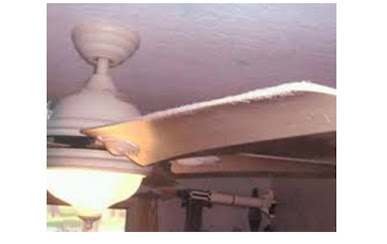
As the fan blades cut through air, they develop charge due to friction. This leads to accumulation of dust particles as these dust particles are also usually charged.
The leading edge of the blades usually develops the thickest layer of dust.
That’s because the leading edge [the edge first cutting the air as the blade spins] encounters the most friction and develops the largest charge.
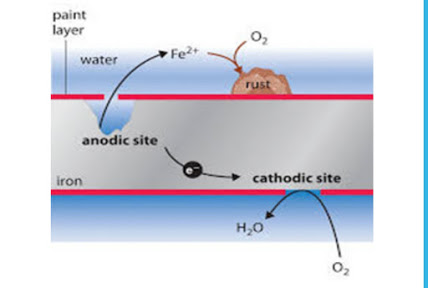
Rust is actually oxide of iron. Rusting is nothing but the reaction of iron with oxygen.
When iron or an alloy that contains iron, like steel, is exposed to oxygen and moisture for a long period of time. Over time, the oxygen combines with the metal at an atomic level, forming a new compound (oxide).
The compound formed by this reaction, the rust is a weaker material and it makes the structure brittle.
Rust was originally a synonym for iron oxides, but is now the general term for metal corrosion. It is a flaky and fragile substance, which is undesirable for most applications that metals are used for.
The rate at which a metal rusts depends on its surface area and environment. Moist environments cause significant rust, while salt water accelerates rusting even further.
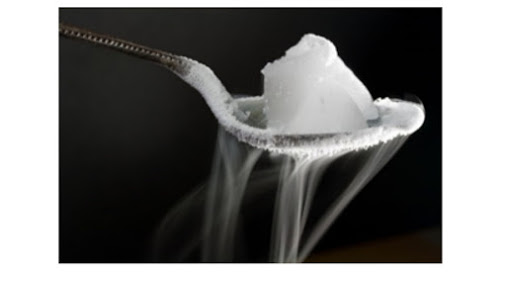
Dry ice is the solid form of carbon dioxide.It is used primarily as a cooling agent or fire extinguisher.
It is used primarily as a cooling agent or fire extinguisher. Its advantages include lower temperature than that of water ice and not leaving any residue (other than incidental frost from moisture in the atmosphere). It is useful for preserving frozen foods where mechanical cooling is unavailable.
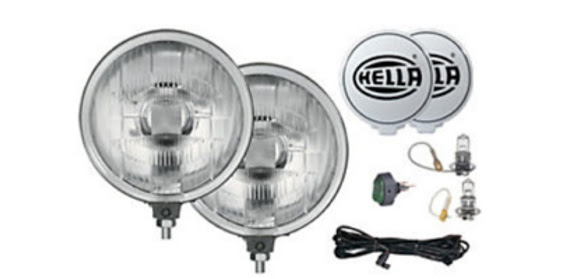
Front fog lights are of use in extremely poor visibility. In this situation, the normal low-beam lights reflect off the fog in front.
Fog lamps are intended to provide an adjunct to the low beams. Because fog hovers close to the ground, the lamps are designed to shine down, illuminating the road beneath the fog.
The top of the beam is cut off sharply so the light does not shine into the fog and reflect off it.
Front fog lights are mounted low down on the bodywork, and are angled down at a steeper angle than normal headlights.
The beam pattern is wide and flat, with a distinct cutoff at the top-this reduces the amount of light reflecting off the fog.
By switching the low-beam lights off, the driver can use the fog lights to illuminate the road directly in front of them, so they can proceed at low speed.
A tube is more efficient than a solid in terms of strength to weight ratio. So, bicycles frames are made of hollow pipe to get the maximum strength while keeping the weight to a minimum.
Lightness is one reason but the main one is tubing for bikes is made by folding flat sheets of steel therefore there is a hole in the middle of it as you’d get in anything made in that manner eg a drinking straw.
Tubes will also give or maybe act as suspension so making the frame more comfortable to ride.
However, if you ignore the weight benefit of a tube, the solid steel is stronger of the same diameter.
In the early days of bicycle making the jointing of the flat steel sheet into a tube could be found by running a finger along it to find the seam. That is still true of cheap bike frames nowadays and in the UK where I’m from those cheap and heavy tubes were called “gas pipe tubing” as that is what most steel or iron tubes were used for.
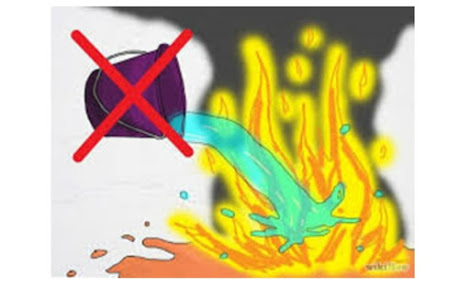
Since the specific gravity of oil is less than water, it floats over water.
As a result, water will not put out oil fires since the burning oil will float on top of the water and spread.
Throwing sand, table salt, or baking soda on the flames will extinguish them. Also a damp towel spread over the fire will cool and smother it but all the water must be wrung out.
R. Tradwell filed a Brittish patent, number 792, for the first coiled spring back in 1763. The word coil meant to wind cylindrically or spirally. This new patent was considered a step up from the leaf spring which had to be separated and lubricated often or it was very squeaky. The new coiled spring didn’t have to be spread apart.
In the year 1857, the steel coil spring was officially invented and was often used in the construction of chair seats. Ever since the inventions of these coil springs, springs have been used in everything from shoes to trampolines. They helped make the car industry what it is today. Springs are used in every type of machinery and they really do help make the world go around.
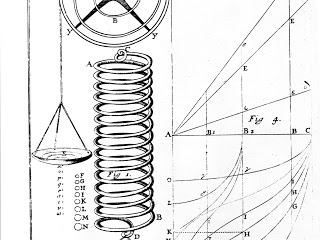
Springs are in general used as energy storage and conversion devices.
When compressed or elongated, springs absorb energy (convert worked up energy into potential energy). This energy is used for various tasks (reconversion of potential energy into other forms of energy).
For example- in children toys, where we rotate the spring to store energy into spring) and then when released the car starts running (conversion into kinetic energy).
Springs are made of elastic materials such as steel, iron etc.
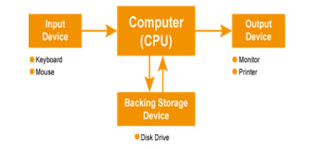
A computer is an electronic machine that processes information— it takes in raw information (or data), stores it until it’s ready to work on it, chews and crunches it for a bit, then spits out the results at the other end.
All these processes have a name. Taking in information is called input, storing information is better known as memory (or storage), chewing information is also known as processing, and spitting out results is called output.
Input: Your keyboard and mouse, for example, are just input units—ways of getting information into your computer that it can process.
Memory/storage: Your computer stores all documents and files on a hard-drive: a huge magnetic memory.
Processing: Your computer’s processor (sometimes known as the Central Processing Unit) is a microchip buried deep inside It.
Output: Desktop (monitor), printer etc. are the output tools through which we get the information out.
An O.S. & a Computer Program (Software)-
A computer program or software is line of code that tells computer how to identify the data, process it and get the final output in the form of a mathematical solution of GUI display.
There is something called Operating System (O.S.) e.g. LINUX, Windows 10 which does this task. All other software interact with O.S. only to carry out different functionalities.
The only difference between the two is how the light is generated at the back of the screen.
How an LCD Television Works
LCD television screens are made up of liquid-crystal gel sandwiched between two panes of polarized glass. When you power on the television, the electric current passes through the liquid-crystal display, altering its structure. The liquid-crystal molecules coil and uncoil. This creates a shuttering effect, whereby light is either allowed to pass through or not. This variation in light and dark on the screen, is what the viewer perceives as images.
Unlike plasma TVs, the liquid-crystal does not create its own light. It requires another light source. In the case of LCD TVs, the screen is lit by fluorescent tubes.
How an LED Television Works
An LED TV is just a new generation of LCD TV. The difference, is that an LED TV is not lit using fluorescent tubes, but rather a series of light emitting diodes (LEDs). There are three basic types of LED televisions, and each has its own specific format.
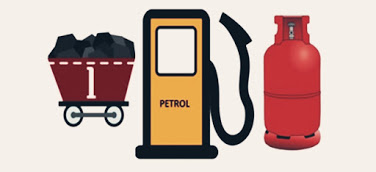
Coal and petroleum have been formed from remains of dead animals and plants which has been subjected to various biological and geological process over millions of years. “Coal is the remains of trees, ferns and other plants that lived millions of years ago while Oil is the remains of millions of tiny plants and animals that lived in the sea.“
These were crushed under the earth by earthquakes or volcanic eruptions. They were pressed down under the layer of earth and rock and slowly decayed into the coal under the high temperature and pressure.




 Science-Blogger Curiosity
You must be logged in to post a comment.