
Atoms, electrons, neutrons and protons are the basic building blocks of matter. Neutrons and protons make up the nucleus of an atom, while electrons circle this nucleus.
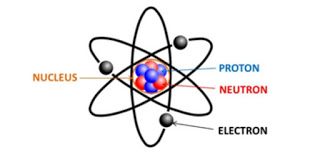
Electron- An electron is bound to and orbits the nucleus of an atom. This indivisible particle has a negative charge, often referred to as “minus 1.” Its mass is 1/1,837 of the mass of a proton. An electron was discovered by J.J. Thomson in 1897.
Proton- Discovered by Rutherford in 1920, Proton Elements get their atomic number based on the number of protons found in each atom. Proton carries a positive charge, referred to as “1” on the atomic weight scale. A proton has a mass 1,837 times greater than that of an electron.
Neutron- Located in the nucleus of atoms, neutrons have mass slightly lower than those of protons. This indivisible particle gets its name for the fact that it has no electrical charge. It is 1,839 times the size in mass of an electron.
 Science-Blogger Curiosity